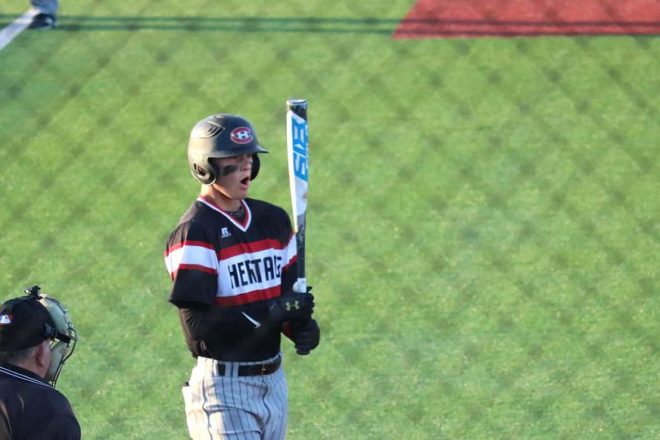
A hitter walks to the plate thinking about his last strikeout, his batting average, and the runner he needs to drive in.
By the time the pitcher comes set, he has added three swing corrections to the conversation.
That’s a lot happening in his head.
Very little of which helps him see this pitch well, be on time or make hard contact.
If you coach baseball or are the parent of a baseball player, you have watched this happen.
If you play baseball, you have no doubt experienced it first hand.
The question is how to bring your attention back to a job you can actually execute on in that moment to give you the best chance for success?
What to do to help simplify your focus?
What I do with the players I coach is have them choose three short cues that describe how they want to prepare and compete.
We write them down, connect them to their routine, and practice returning to them after each pitch.
In this article I will share with you baseball examples that make this practical.
Cincinnati Reds Hall of Famer and lifetime .300 hitter Sean Casey, also hitting coach for the NY Yankees, Team USA in the WBC and an analyst for the MLB Network describes a card he kept in his back pocket that said “See The Ball, Be Easy, Hammer It”
Jake Fraley uses the same words to reset.
Anthony Volpe emphasizes timing and ease.
Konnor Griffin writes his cues of Calm, Rhythym, Middle in a journal.
The reminders inside Bobby Witt Jr.’s helmet give us another way to keep this process of the 3 keys visible.
The wording can vary. Each player needs a clear place to direct his attention.
Give your focus a job
“Focus” is an incomplete instruction until the player knows what to focus on.
“Get a hit” names a result. “Be on time” gives a hitter something to prepare for.
“Don’t walk him” can leave a pitcher thinking about the very result he wants to avoid. “See the target” brings his attention back to the pitch he is about to deliver.
Your three keys should be short, personal, and connected to actions you can choose.
They should also support your baseball instruction.
Work to find language that fits your swing, delivery, or defensive responsibility.
Review the cues before the action begins. Once the ball is in flight, let your preparation guide your response.
Trying to recite a checklist while tracking a pitch defeats the purpose of simplifying.
Sean Casey connected his cues to the on-deck circle
Sean Casey explains that MPM Coach Harvey Dorfman encouraged him to write his three reminders on a note card.
Casey settled on “See the ball, be easy, hammer it.”
He kept the card in his back pocket and reviewed it in the on-deck circle before walking to the plate.
That detail matters. He gave the reminder a specific place in his preparation.
A player can have useful words written in a notebook and still forget them when the game gets difficult.
Connecting the words to an existing routine makes them easier to revisit.
For a hitter using Casey’s language, “see the ball” can direct attention toward picking up the pitch.
“Be easy” can serve as a reminder to release unnecessary tension.
“Hammer it” can reinforce a committed swing at a pitch that fits the plan.
Those are possible applications to discuss with your coach; the cue has to mean something clear to the player using it.
Jake Fraley shows how a reminder can support a reset
Jake Fraley also carries a card with the same three keys as Casey.
Fraley considered writing his own sayings, decided to use Casey’s, and returns to the card for mental resets during the game.
You can borrow another player’s words when they fit your needs. You still have to practice the response they represent.
Suppose you chase a slider in the dirt. Between pitches, release your grip, take a comfortable breath, and return to the approach you chose.
Get your eyes ready for the next pitch.
The reminder becomes useful through what you do after reading or recalling it.
Build that response during practice so it is familiar when the count reaches one and two with the tying run on base.
Anthony Volpe and Bobby Witt Jr. keep the message tied to hitting
In his interview after game 4 of the World Series, Anthony Volpe describes (1) seeing the ball, (2) being easy, and (3) being on time for the heater. His explanation stays close to the task in front of him.
That simplicity can coexist with scouting information. You can know a pitcher’s tendencies, understand the count, and decide which part of the zone you want to attack. Your cues help you prepare to carry out that plan.
The photo of Bobby Witt Jr.’s helmet shows “See the ball,” “Stay loose,” and “Be on time.” It offers a visible example of keeping reminders close to the moment of preparation. He talks more about this in a podcast we did together you can access here.
Choose a place you will actually use: a pocket card, a journal you open before batting practice, or another appropriate spot in your preparation area.
Make sure the reminder supports your routine without distracting you once play begins.
Konnor Griffin connects preparation with an honest review
Konnor Griffin describes sitting down to journal when he arrives at the field.
His three hitting reminders are (1) being calm, (2) having rhythm, and trying to drive the ball back up the (3) middle.
He also explains how he responds to a O-for-3 game.
He writes three things he is grateful for, then reviews his at-bats and identifies positives, including good takes when he stayed with his plan.
He is discussing his journaling process for both pre and post game.
This gives players a useful way to separate the result from the decisions that produced it.
A strikeout can contain a disciplined take worth repeating. A hit can come from chasing a pitch outside your plan. Both deserve an honest look.
After the game, ask yourself where you followed your approach, where you left it, and what you need to practice next. Recognize useful decisions while addressing mistakes. That is how reflection becomes preparation for tomorrow.
Build your three keys before the next practice
Start by remembering your best at-bats.
- What did your preparation look like?
- Where were your eyes?
- How did your body feel?
- Which words helped you commit?
Write three brief cues and check each one:
- Can I act on this before or during the next pitch?
- Does it direct me toward something useful?
- Can I remember it when the game gets uncomfortable?
For a hitter, “See it. Stay loose. Be on time.” might be a useful starting point.
Another hitter may prefer “Rhythm. My zone. Commit.” Choose with your coach and define what each cue means in your preparation.
Avoid packing several mechanical corrections into each phrase.
Keep the purpose clear enough that you can say the cues, get ready, and compete.
Run the fifteen-pitch focus drill
Use three rounds of five pitches in batting practice. Have a partner watch your preparation while you track your own attention.
Round one: establish the routine. Read your three keys before the round. Put the card away, take a breath, and get ready. Between pitches, use your normal reset and briefly recall a cue when needed.
Round two: add a count. Begin each pitch with an imagined 1-2 count. Agree on your two-strike approach, then see whether you can keep your preparation clear when the count creates urgency.
Round three: add a situation. Picture a runner on third with less than 2 outs. Clarify the hitting plan with your coach. Prepare for each pitch with the same attention to your routine.
After every pitch, award one process point if you completed your preparation and committed to the plan.
Award zero if you skipped the routine or carried the last pitch into the next one.
Your partner can observe the routine; you must honestly assess your attention and commitment.
Keep the batting result in a separate column.
A hard lineout and a bloop single tell you something about the result.
The process score tells you whether you practiced the behavior you intended to train.
Review both without turning either into a judgment of your worth as a player.
Adapt the keys for pitchers and fielders
Pitchers can start with “Breathe. See the target. Commit.” A
gree on the pitch and intended location, settle your attention, and execute.
Keep the routine within the pace and rules of your game.
During a bullpen, record whether you completed the routine and committed to the pitch, then record location separately.
An infielder might use “Know the situation. Get ready. Read the ball.” Know the outs, runners, and your responsibility before contact. Get into your ready position and react to the ball off the bat. Change the situation between ground balls in practice so players have to prepare again.
These are starting examples. Each player should understand the action behind the words and adjust them with a coach.
Coach the next response
Watch the repetition after the mistake. A player who boots a ground ball and then prepares for the next one is giving you a behavior to reinforce.
Be specific: “You took a breath, checked the situation, and got ready again.” The player now knows what to repeat.
Keep longer mechanical instruction for a moment when the player can work on it. During the focus drill, make feedback serve the cue or routine you are training. If the words create confusion, simplify them together.
Before your next practice, write your three keys. Choose when you will review them. Complete the drill, then record one example of a successful reset and one response you want to improve.
The next pitch gives you another opportunity to prepare. Give your attention a clear job, and practice doing it.
Your Next Step!
If you’re a player, coach, or parent who cares about gaining a competitive edge, you’ll want to join my Baseball Mental Mastery (BAMM) Course Insiders List. I designed BAMM to give you a complete system for mastering the mental game of baseball to compete with confidence, consistency, and mental toughness — and registration opens soon!
When you join the BAMM Insider’s List, you’ll get first access when BAMM opens and receive a special discount.