How Olympic medalists refocus after a mistake (and how to train it)
Olympic medalists make mistakes. They miss landings. They lose rhythm. They make a poor tactical decision. They feel the weight of the moment.
What separates elite performers is not a mistake-free competition.
It’s the speed and quality of the return.
At the Olympic level, the field is too good and the margins are too small to spend the next thirty seconds competing with the last thirty seconds.
Whether it was a second ago or a season ago, you must move on to the next… it’s coming.
The athlete must recognize what happened, release what no longer helps, and refocus on the next controllable action.
Today I will show you the refocus system used across elite sport: Recognize, Release, Refocus. We will break down the mechanics, apply them to Olympic-style performance moments, and build a training plan coaches can use at any level.
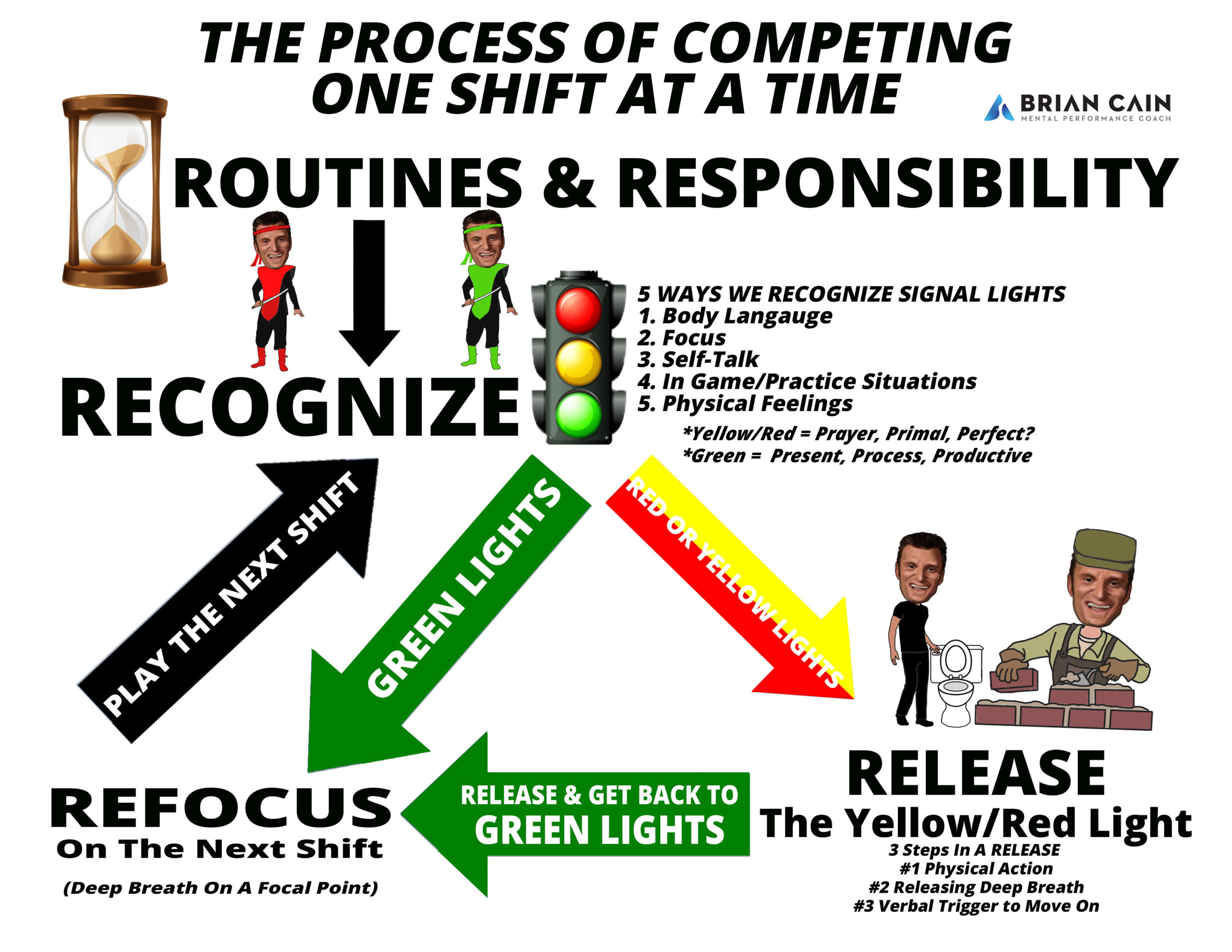
My Process of The R’s – adapted from my mentor Dr. Ken Ravizza – Recognize, Release, Refocus.
The Medalist Mindset
A medalist mindset is not, “I will never make a mistake.”
That belief is fragile because one mistake destroys it. A stronger belief is: “Mistakes may happen. I know how I will respond.”
The athlete cannot control every event, opponent, official, condition, or result. The athlete can train response-ability. E plus R equals O.
The Event plus the Response equals the Outcome.
The response does not guarantee the medal. It gives the athlete the best opportunity to stop one error from becoming three.
In elite competition, the return itself is a competitive skill.
[STEP ONE: RECOGNIZE] Refocusing begins with awareness. Athletes must recognize when attention and state have left the performance zone. Use signal lights. Green means body language, focus, and self-talk support execution. Yellow means drift has begun. Red means emotion is controlling behavior. Each athlete needs personal markers.
A gymnast may go yellow when breathing becomes shallow and the mind begins replaying the landing. A swimmer may go yellow when the race plan disappears and attention moves to the lane beside them. A track athlete may go yellow when one poor hurdle creates mechanical panic. A team-sport athlete may go yellow through dropped eyes, silence, or frantic speed. The earlier the athlete recognizes yellow, the smaller the correction required. Awareness is not weakness. It is the doorway to choice.
[STEP TWO: RELEASE] Release is a brief, deliberate closing of the previous moment. Use three elements. A physical action or association. A breath connected to a focal point. A verbal cue. The physical action might be brushing the hands, resetting the grip, touching a wristband, stepping across a line, or shaking the shoulders loose. The breath helps regulate activation. The focal point gives the eyes somewhere useful to land.
The cue might be “next,” “present,” “free,” or “good.” The word should be short and personally meaningful. Release does not mean forgetting the technical lesson. It means delaying analysis until analysis can help. Competition is often the time to execute. Review is the time to study. Take the correction that can be used now. Release the emotional replay.
[STEP THREE: REFOCUS] Refocus ends forward. Use a final TIF: Thought, Image, or Feeling. A diver may image the opening line and feel patience through the takeoff. A volleyball player may think, “High hands,” and see the next approach. A middle-distance runner may feel tall posture and hear the cue, “smooth and strong.” A shooter may see the center of the target and feel the exhale.
The TIF is not a long speech. It is the final instruction that organizes attention and movement. Recognize where you are. Release the old moment. Refocus with one clear TIF. Then act.
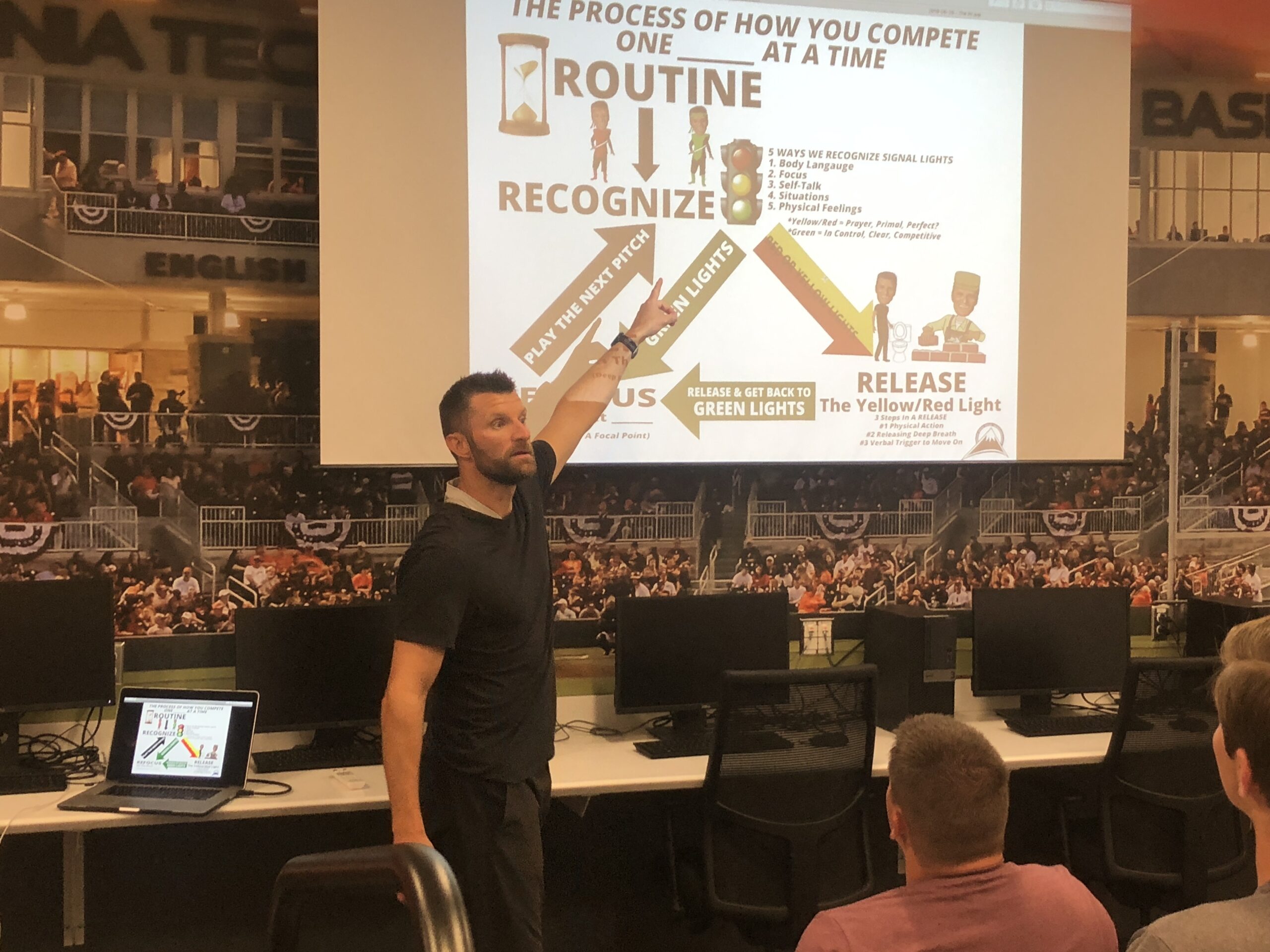
Teaching the Process of The R’s – adapted from my mentor Dr. Ken Ravizza – Recognize, Release, Refocus
An Olympic-Style Composite Example
Consider a composite scenario built from patterns common in elite competition. An athlete enters a multi-round Olympic event as a medal contender.
Early in the final, a technical error produces a lower score than expected. The crowd reacts. The scoreboard changes. Years of work seem to compress into one moment.
The untrained response is to chase the lost points. Mechanics become forced. Attention moves to medals, judges, and consequences.
The trained response is shorter. Recognize: jaw tight, eyes on the scoreboard, thought racing into the future. Release: turn from the display, loosen the hands, one long exhale on a chosen focal point, cue “present.” Refocus: see the opening position of the next attempt and feel the preferred rhythm. Then commit.
The routine does not erase the earlier score.
It prevents the earlier score from stealing the next opportunity.
That is what Olympic-level refocusing demands.
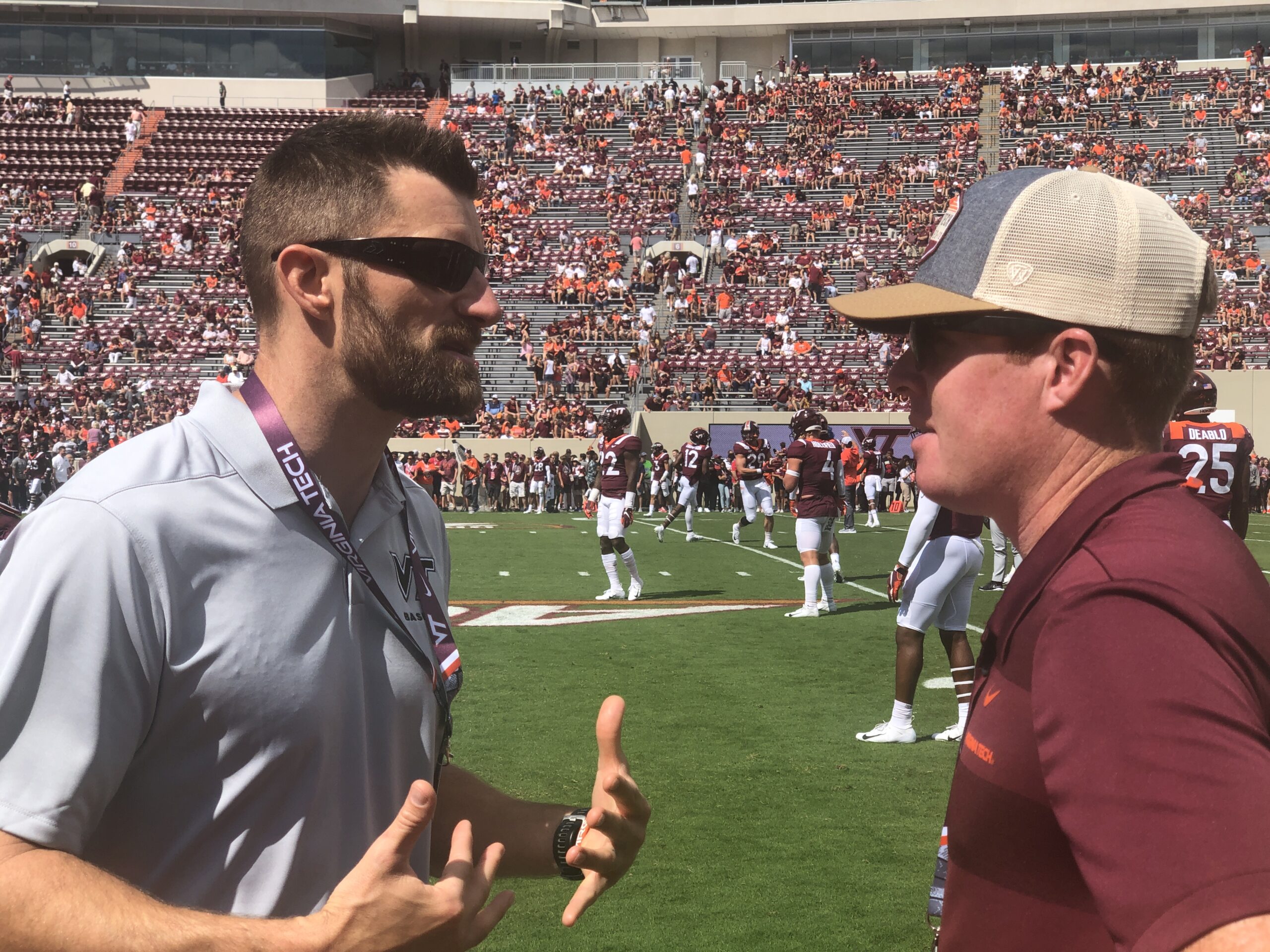
Discussing release routines with a coach pre-game
Train The Routine Before The Stage
The Olympic final cannot be the first place an athlete tries a refocus routine. Begin at low intensity.
After every ordinary error, complete the same sequence. Then add pressure progressively.
Add an observer. Add a score. Add a time limit. Add fatigue. Add consequence.
Create a disrupted warmup or changed order. Use an unfavorable call or simulated delay.
The goal is not to manufacture panic. The goal is to make the return familiar while activation rises. Do a little a lot.
Measure Return Speed And Quality
Coaches measure outcome, but the return is often invisible. Make it visible. Score three things: Recognition speed. Routine completion. Quality of recommitment. A one-to-five score works.
You can also use a simple yes/no checklist.
- Did the athlete identify yellow?
- Did the athlete release through body, breath, focal point, and cue?
- Did the athlete execute the next TIF with commitment?
The next result may still be imperfect. Do not confuse outcome with response quality. A world-class refocus can be followed by a difficult bounce. Reinforce the trained behavior.
[USE IMAGERY FOR MISTAKES, NOT ONLY SUCCESS] Many athletes use imagery to picture perfect performance. That is useful but incomplete. Image the disruption. See the mistake. Feel the emotion honestly.
Then rehearse Recognize, Release, Refocus and see the return. This builds adaptable confidence.
The athlete is no longer confident only in a perfect script.
The athlete becomes confident in the ability to respond when the script changes.
Use all senses. See the venue. Hear the crowd. Feel the body activate.
Then practice the breath, focal point, cue, and next movement.
Coach Language In The Moment
In high pressure, say less. “Use your routine.” “Breathe and find your focal point.” “Next controllable.” “Show me the response.”
Do not add a new mental strategy during the final.
Return the athlete to the language rehearsed in training.
After the event, use a fuller review. What was the first yellow signal? Which release element worked? What did the final TIF direct? What will be adjusted before the next competition?
Short in the moment. Curious in the review.
The Team Around The Athlete
Olympic performance may appear individual, but it is supported by a team.
Coaches, medical staff, strength staff, and family can either reinforce the reset or keep the athlete inside the mistake.
Agree on language before competition. Decide who communicates.
Protect the athlete from five competing instructions.
The support team should model composure, clarity, and belief in the process.
The coach’s body language is part of the athlete’s environment.
The Direct Tie To All 10 Pillars of Mental Performance
Pillar 4, Self-Control and Discipline, anchors the choice after the mistake.
Pillar 1, Elite Mindset, expects adversity and frames it as usable information.
Pillar 2, Motivation and Commitment, reconnects the athlete to years of purposeful work.
Pillar 3, Focus and Awareness, recognizes the signal and directs attention.
Pillar 5, Process Over Outcome, moves the mind from medals and scores to the next action.
Pillar 6, Mental Imagery and Meditation, rehearses disruption and recovery.
Pillar 7, Routines and Habits of Excellence, makes the return repeatable.
Pillar 8, Time Management and Organization, protects preparation, recovery, and competition logistics.
Pillar 9, Leadership, creates a clear, composed support team.
Pillar 10, The Right Culture, treats refocusing as a trained standard rather than a rescue tactic.
Common Mistakes
Mistake one is telling athletes to forget it without a release behavior.
Mistake two is practicing only perfect imagery.
Mistake three is changing cues in the big moment.
Mistake four is judging the routine by the next result.
Mistake five is overwhelming the athlete with instructions.
Keep the routine short, personal, practiced, and forward.
A Seven-Step Medalist Refocus Plan
- 1. Define green, yellow, and red signals.
- 2. Select the physical release, focal point, breath, and cue.
- 3. Build the final TIF.
- 4. Use the routine after ordinary practice errors.
- 5. Add score and observation.
- 6. Image a major mistake and rehearse the complete return.
- 7. Simulate a high-pressure disruption and score recognition, routine, and recommitment.
Implementation Notes for Coaches
The fastest way to install medalist-level refocusing is to translate the idea into behavior that a camera could capture.
For this topic, look for a breath, a release cue, decisive posture, and fast return to the next target. ‘
Explain why those behaviors matter, demonstrate them, let the athlete personalize the language, and then evaluate the response in practice.
If the standard remains abstract, athletes will agree with it in a meeting and lose it when emotion, fatigue, uncertainty, or consequence enters the environment.
Use a simple progression: teach the response when the athlete is calm, rehearse it in a normal drill, and then pressure-test it.
One practical option is to inject realistic errors into training and measure both return speed and return quality instead of pretending mistakes can be eliminated. Keep the feedback tied to the controllable behavior. Ask, “What did you do well? What could you do better? How will you make that improvement on the next rep?” That Well-Better-How review protects accountability while keeping the athlete connected to growth.
This is also where Pillar 4 — Self-Control and Discipline becomes part of the daily culture instead of a lesson athletes hear once.
Model the response as a coach, reinforce it when the outcome is good and when it is not, and measure improvement over time.
Do a little a lot. Repetition makes the response available when the athlete needs it most.
The Standard Going Forward
Olympic medalists are not mistake-free.
They are prepared to return.
Recognize the signal.
Release the old moment.
Refocus with a clear thought, image, or feeling.
Then commit to the next action.
The previous score may remain on the board. It does not have to remain in control of attention.
Train the return until it becomes one more part of performance.
Because at the highest level, the speed and quality of your refocus can be the difference between carrying a mistake—and competing for the next moment.
Your Next Step!
If you are a coach looking to master mental performance coaching, the missing link in your clients’ and athletes’ performance, join my MPM Coaches Insiders List and receive my best strategies for coaching mental performance and save $200 off my MPM Certification Course when it opens this fall.
💻 Join my MPM Coaches Certification Insiders List & Save $200
👍 Take my FREE 3 Day Coaches Mini-Course