The Habit Loop
Understanding the habit loop is the key to consistency. Be intentional about setting your triggers so you can reap the rewards of your routine. — Brian Cain
If you want to be ultra-consistent in performance, it starts with having an understanding of the habit loop.
When you understand the three steps in the habit loop, you can be much more intentional and consistent with executing your routines in life and in competition.
In his book The Power of Habit, Charles Duhigg walks us through the three steps in a habit loop.
The three steps in a habit loop
(#1) The first step is that there’s a trigger. When that trigger happens,
(#2) It puts you into a routine, and the reason why we have routines is so that we get a
(#3) Reward.
Understand this process and you can be well on your way to establishing and strengthening positive routines and breaking bad ones.
Negative and positive habit loops are formed the same way. Just like you have good habits that help you compete at a high level, there are bad habits that hold you back. When you understand the habit loop, you can break the bad habits and reinforce the good ones.
The key is to become aware of these habits, aware of the triggers that start them, and then have something to go to so you can stop the negative habits and shift into a more positive and productive response.
Examples of a habit loop
A negative habit loop would be:
(#1 – TRIGGER) A referee or an umpire makes a bad call.
(#2 – ROUTINE) I go palms up, roll my eyes, and have bad body language.
(#3 – REWARD) Everyone knows I got cheated by an umpire’s bad call.
W-a-a-h-h (insert child crying sound).
That’s a negative habit loop. We need to break that and here’s how.
First, understand that you aren’t so bad that you need every call to go your way to win; that’s part of having an elite mindset. Remember, you control how you respond to what happens around you — you can overcome anything thrown your way.
Let’s look at the same example above within the context of a positive habit loop.
(#1 – TRIGGER) Umpire or ref makes a bad call.
(#2 – ROUTINE) I stay big and my self-talk is “GOOD. So what? Give it to them — I’ll get the next one!” Physically, I stay big. I take a deep breath and think about blowing away that last pitch and moving on to the next one, being present and ready to compete.
(#3 – REWARD) What’s the reward? I’m able to move on to the next pitch or play with a clearer focus and stay present and locked in on competing for that pitch or that play.
If you’ve been paying attention in this training program, you have probably already set a trigger for you to consistently watch the videos and reading the text. It might have been set for you by a coach or maybe you took accountability for your mental performance development and set it yourself?
That trigger may be when you eat breakfast, get to the locker room, pull up to the school in your car or get home from practice.
If you have made it this far, it’s probably not a trigger of “I’ll do it when I feel like it” — that isn’t a trigger. It’s a poor mindset that will lead you to falling short of your potential.
Our vision for you as we created this program was that as you’re eating breakfast in the morning, you are watching the video(s) for the day and taking notes in your journal, considering this program as breakfast for your mind.
Then when you get to school, you are breaking down what you learn with a coach or teammate / accountability partner and talking about how you are going to apply this to your mental performance toolbox.
That scenario of watching the video(s) and reading this text as you eat breakfast is in itself an example of a habit loop:
(#1) Trigger – (sitting to eat breakfast)
(#2) Routine – (taking out this book, watching the videos for the day)
(#3) Reward – (building mental toughness, having a plan for what you can do to become more, growing your mental performance toolbox, having a great way to connect with teammates, accountability and training to do what the best athletes on the planet do to give them the mental edge.)
Now let’s cover a sport-specific example from football.
Let’s take a wide receiver.
(#1) Pre-play routine TRIGGER: I’m looking to the sidelines and I get the play call. I’m getting into my stance. Before I get into my stance I’m going to take a deep breath.
(Remember, we’ve been working on our 6-2-8 breathing. All that meditation off the field has set this receiver up and prepared him for when he takes a breath pre-snap as he sinks into his stance as a receiver, helping him get into the present moment and compete one play at a time.)
(#2) The receiver takes his ROUTINE breath, gets into his stance as part of his routine and the (#3) REWARD is that he is in the present, competing one play at a time and giving himself the best chance for success on that play.
Remember that you have to be in control of yourself before you can be in control of your performance.
The reward of that pre-snap routine is that the receiver is taking a breath, which is HOW he is going to be in control of himself so he has the best chance to control his performance on that next play and make one play at a time.
So, let’s review.
(#1) Trigger — the receiver gets the play call from the sideline.
(#2) Routine — he takes a deep breath and maybe even visualizes the route he is going to run as he is getting into his stance.
(#3) Reward — he is in the present moment competing one play at a time, giving himself and his team the best chance for success.
In basketball, you see habit loops all the time.
At the free throw line the player gets the ball (TRIGGER), takes a deep breath looking at the rim and does three dribbles (ROUTINE), and then takes the shot with increased presence and increased chances of making the shot (REWARD). By having a routine the basketball player does the same thing at the line every time, whether in a game, practice or with the game on the line.
In the resources section for today, check out the video of 2018-2019 Big East Conference Men’s Basketball Player of the Year Markus Howard taking intentional-foul free throws with nobody standing around the key. Watch how he steps in and simulates making contact with his teammates who aren’t there because it’s such a part of his routine. Remember, we don’t rise to the occasion. We sink to our training and habits. This is a great example of exactly that.
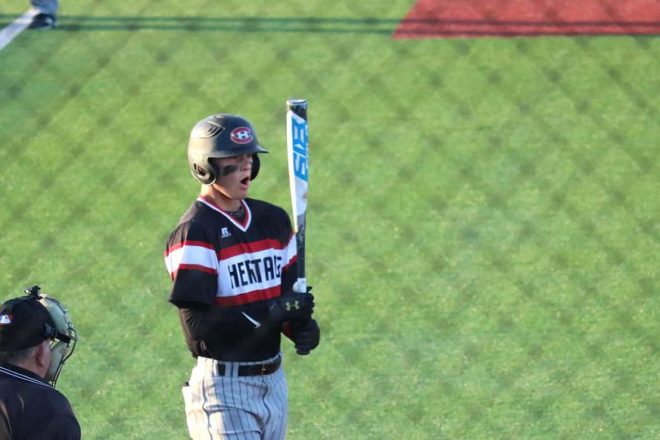
In baseball or softball, you’re going to see a pitch (TRIGGER). The hitter steps out of the batter’s box, looks to third base for the sign and before getting back into the box looks at a focal point on the bat and takes a deep breath (ROUTINE). The hitter is in control of himself and in the present as a result of executing his routine (REWARD).
Today your goal is to write out your routines.
Writing out these routines helps you become more consistent in executing them, because in order to write them out you must become more aware of them, and awareness is the first step in all performance change/growth.
Oh… you want an example from the weight room? POW! Let me give you one.
Trigger — it’s my turn to get on the platform to hit a set of front squats.
Routine — big deep breath with a forceful exhale looking at the bar, as trigger to get myself “locked in” and ready to go. Staying in my routine, I walk with huge body language onto the platform. I grab the bar. I get underneath, take another breath with a forceful exhale to get energized, then, POW — it’s ON! I pop the bar and I’m getting into my lift.
What’s the reward? I’m engaged, I’m energized, I’m in the present and I’m dialed in to attack that one set because I’m not trying to do an hour workout. I’ve used my training to see it as a one-minute workout 60 times.
I attack each set as if it’s the most important set I am ever going to hit.
Why? Because it is. Why? Because it’s the next set, and I am a one-set warrior in the gym and a one-shift warrior on the ice and a one-pitch warrior on the field.
Make sure you intentionally follow the three steps to the habit loop to assure that your routines are on point and will be there under pressure and stress.
Set your triggers, be able to describe your routines and position yourself to get the reward.
NEGATIVE HABIT LOOP
TRIGGER: Bad Call
ROUTINE: Bad Body Language
REWARD: Feel Sorry for Me
POSITIVE HABIT LOOP
TRIGGER: Bad Call
ROUTINE: Big Body Language, Breathe, say “GOOD”
REWARD: Ready for Next Play
Here is a Mental Performance Daily Podcast where I discuss The Habit Loop.