The Personal MVP Process
The Personal MVP Process is a tool used to help you figure out who you are, what you stand for and what your purpose is.
This is a good tool for you to develop as the leader of your own life.
This is not only an incredibly valuable tool for improving leadership; it can also serve as a fantastic motivational and goal-setting tool.
MVP stands for:
M = Mission. Your mission is your personal statement of purpose. The why you do what you do. Missions have no finish line.
V = Vision. Your vision is a list of the outcome goals you are after. Visions have clear finish lines. When creating a personal vision, we will select visions/goals for the 3 key areas of:
- Energy/personal
- Love/family/relationships
- Work/service.
We also break down each of these three categories into subcategories that you can adjust to more specifically fit your specific needs.
P = Core Principles. Your core principles are the core values or character traits that you are intentionally going to live that make you YOU and provide the best chance for success in achieving your mission and vision.
We get our clients to create an MVP process for each quarter of their life, every 90 day period and then revisit the process to develop an updated vision in the 3 keys areas listed above.
The life mission, life vision and definitions of success will often stay the same for up to a year, but they can certainly evolve as one’s life situation changes.
The definition of success is a critical part of the Personal MVP Process because it brings the focus back to where it belongs: to the individual. You have to fight against the tendency to fall into the comparison trap where you use someone else’s definition of success.
Start with leading yourself to create your personal MVP process.
Reviewing this in your accountability partner meetings or meetings with your MPMC or MPPTC can serve as a tremendous leadership developmental tool.
Most athletes make the mistake of looking outside for the answers to their questions instead of looking inside.
They go looking outside for approval of others instead of inside to determine if what they want or what they are after aligns with who they want to become. You need to look inside first.
This picture of a person looking inside of himself to see who he is, to see what’s important to him and what he truly wants, changed my life. The picture was put on an overhead in a Philosophy of Sport class by my mentor Dr. Ken Ravizza in November 2002.
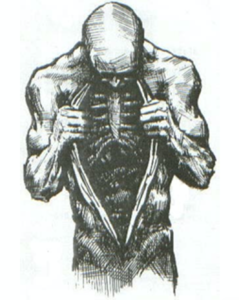
I got it tattooed on my right quad three days later and it’s been a visual representation for me of the importance of looking inside vs. outside for answers.
It’s also a big reason why for a long time I currently followed ZERO PEOPLE on Instagram and Twitter. I am back into the game for business purposes.
I value the freedom and time for introspection, self-reflection and internal observation by not having that distraction far outweigh the distraction of following everyone else’s life instead of focusing on living my own. I encourage you to take part in your own version of this digital detox.
I am super social and I get energized by being around others. I like to think I’m a people person, but I also like my own space to go deep inside and continue to learn who I am, what’s holding me back and how I can continue to progress into who I want to be so that I can educate, empower and energize others — like YOU — to become their best.
To ask yourself these deep questions takes time and space that you can’t create if you are a dog on the digital leash of your cell phone 24/7 — and A LOT of people reading this right now are that way… are you?
Two of the most difficult questions that you’ll ever be asked are (1) “Who are you?” and (2) “What is it that you really want?”
You will get asked “So, what do you do?” a lot more than “So, who are you?”
That speaks to the external world we live in where what you do is often seen as who you are.
I challenge you to separate the who and the do. Your sport is what you do, not who you are. You are MUCH bigger than that.
Matt Purke was the first round pick of the Texas Rangers in 2009. He chose to attend TCU versus signing a professional contract.
After Purke started his freshman season as TCU’s #1 pitcher and was 11-0, I asked him how he was able to be such a fierce competitor on the field and yet so humble off the field. His answer was one I will never forget:
Cainer, it’s easy. Baseball is what I do, not who I am. When I am between the lines, I am as competitive as anyone on the planet, but that doesn’t make me any better or worse than anyone else off the field. Off the field I am who I am and on the field it’s what I do, and I try to separate the two.
If you have the opposite mentality of Matt Purke and you think that your sport is who you are and that your self-worth as a human is directly correlated to your performance in your sport, you are in trouble. I made this mistake all throughout high school and college.
Don’t personalize your performance. That will create a cloudy perspective in your sport experience and, as Ken Ravizza used to say, “If you make your sport life and death, you will die a lot.”
Your goal today is to begin identifying your MVP Process: your mission, vision and your core principles/core values.
Your Mission
Let’s start with your mission. When you think “mission,” I want you to think of your eulogy for sport, or what they will say about you at your senior banquet. What will others say about you when you’re gone? What do you want them to say about you as a teammate? What do you want them to say about you as a competitor? What do you want them to say about you and how you got after it every day?
My mission is simple: Educate, empower and energize others to be their best. When I got clarity on my mission, I stopped seeing what I was doing as work, a job or a career, and started to WANT to do it more than ever before.
What’s your mission? Maybe it’s “go all out every day.” Maybe it’s be a great teammate, be a great son or daughter and give it everything you have every day. Maybe it’s inspiring others with your performance on a daily basis. I want you to come up with your mission and write that in your journal.
You don’t have to get it right for the rest of your life right now; you just need to get it down on paper. Remember, it’s the start that stops most athletes, and in this program we don’t let the start stop us. We get to work.
Your Vision
When we talk about your vision, think about it as accomplishments you want on your resume. What do you want to get done this season? What are your telescope goals? What are you trying to achieve?
It might be being an All-State player of a Major League Baseball All-Star.
It might be 1,000 yards rushing.
It might be bringing “the juice” every day because if you’re juiceful, you’re useful, and if you’re juiceless… well… you’re useless. You are also responsible for bringing your own juice each and every day.
What’s your vision? As you create that vision, make sure you reverse engineer from the end (telescope), the big domino of being an All-State selection or whatever it is, all the way back down to that small domino (microscope) of showing up every day with a clear plan and a clear purpose for that day’s training session.
Also, be sure that you have the daily habits and actions you need to take are on your success checklist so that you can track your progress.
When you do that, you give yourself the best chance to move that first domino, which we know is the only one you can move today simply because it’s the next one to move. It’s the start that stops most people. Break inertia and everything else will take care of itself.
Your Core Principles
The “P” of the MVP Process is to identify your core principles.
What’s a core principle? Good question.
You’ve probably heard people talk about having core values or character traits. I refer to these as core principles.
I want you to identify a principle that your teammates and other people can count on you to bring every day.
A principle that you see when you look inside of yourself.
It’s a part of who you are and how you want to show up each and every day.
Examples could be discipline, energy, enthusiasm, effort, teammate, positive, etc. It might be being selfless. It might be having integrity. It might be being competitive, being confident, being tough. What’s the principle you’re going to bring to your team and your life from this moment forward? Take a look inside!!!
One question to ask yourself to help identify your principles: If there were three words to describe me, what would they be? Write them down in your journal and then choose one. That one word you pick can be your first core principle.
You can also start by choosing 10 core principles from the list below, then picking five of your 10 and then three of your five. You can start with just one core principle and work to having as many as you’d like. I recommend three to five, but for now start with just one.
Acceptance
Accomplishment
Accountability
Accuracy
Achievement
Adaptability
Alertness
Altruism
Ambition
Amusement
Assertiveness
Attentiveness
Awareness
Balance
Beauty
Boldness
Bravery
Brilliance
Calm
Candor
Capable
Careful
Certainty
Challenge
Charity
Cleanliness
Clarity
Clever
Comfort
Commitment
Common sense
Communication
Community
Compassion
Competence
Concentration
Confidence
Connection
Consciousness
Consistency
Contentment
Contribution
Control
Conviction
Cooperation
Courage
Courtesy
Creation
Creativity
Credibility
Curiosity
Decisiveness
Dedication
Dependability
Determination
Development
Devotion
Dignity
Discipline
Discovery
Drive
Effectiveness
Efficiency
Empathy
Empowerment
Endurance
Energy
Enjoyment
Enthusiasm
Equality
Ethical
Excellence
Experience
Exploration
Expressive
Fairness
Family
Famous
Fearless
Feelings
Ferocious
Fidelity
Focus
Foresight
Fortitude
Freedom
Friendship
Fun
Generosity
Genius
Giving
Goodness
Grace
Gratitude
Greatness
Growth
Happiness
Hard work
Harmony
Health
Honesty
Honor
Hope
Humility
Imagination
Improvement
Independence
Individuality
Innovation
Inquisitive
Insightful
Inspiring
Integrity
Intelligence
Intensity
Intuitive
Irreverent
Joy
Justice
Kindness
Knowledge
Lawful
Leadership
Learning
Liberty
Logic
Love
Loyalty
Mastery
Maturity
Meaning
Moderation
Motivation
Openness
Optimism
Order
Organization
Originality
Passion
Patience
Peace
Performance
Persistence
Playfulness
Poise
Potential
Power
Present
Productivity
Professionalism
Prosperity
Purpose
Quality
Realistic
Reason
Recognition
Recreation
Reflective
Respect
Responsibility
Restraint
Results-oriented
Reverence
Rigor
Risk
Satisfaction
Security
Self-reliance
Selflessness
Sensitivity
Serenity
Service
Sharing
Significance
Silence
Simplicity
Sincerity
Skill
Skillfulness
Smart
Solitude
Spirit
Spirituality
Spontaneous
Stability
Status
Stewardship
Strength
Structure
Success
Support
Surprise
Sustainability
Talent
Teamwork
Temperance
Thankful
Thorough
Thoughtful
Timeliness
Tolerance
Toughness
Traditional
Tranquility
Transparency
Trust
Trustworthy
Truth
Understanding
Uniqueness
Unity
Valor
Victory
Vigor
Vision
Vitality
Wealth
Welcoming
Winning
Wisdom
Wonder
As one of my clients and one of the first UFC world champions and a future Hall of Fame fighter, Vitor “The Phenom” Belfort, says:
The difference between a boy and a man is a boy makes decisions out of preference. A man makes decisions out of principle.
What’s a principle that you’re going to bring to life to help you make decisions on how you will behave on a daily basis?
Your objective coming out of today is that you have started with a personal mission, a personal vision and at least one core principle.
Here is a Mental Performance Daily Podcast where I discuss The Personal MVP Process.